Core Section A: Calculating Simple Cost Savings
Concept Explanation
The green transition of micro and small and medium-sized enterprises (MSMEs) within the Albanian tourism and hospitality sectors is hindered by structural limitations. While multinational chains employ sustainability directors, small-scale operators such as rural hotels, boutique wineries, and farm-to-table restaurants must manage ecological preservation alongside daily survival. Beyond initial financial constraints, these businesses face a complex web of non-monetary barriers—including navigating demanding regulatory requirements within a restricted administrative capacity, severe time limitations, tight operational budgets, and a lack of practical capacity and training, not to mention a dedicated in-house environmental expertise
A major barrier for SMEs is the financial literacy gap—the belief that "going green" is an expensive luxury rather than a cost-saving strategy. Adopting sustainable management (GSTC A1) allows businesses to identify and overcome financial hurdles. This module helps learners move past the "why" of sustainability to focus on "how much" money can be saved and "when" action should be taken to build economic resilience.
Albania's tourism sector faces high seasonality and limited financial resources for large investments. Therefore, this module focuses on "low-hanging fruit"—changes that cost little to nothing but provide immediate returns. Instead of expensive software, businesses can use low-cost monitoring tools like simple spreadsheets for utility bills, waste tracking, supply chain management, and staff task allocation.
A key shift is moving from Traditional Budgeting to Sustainability Budgeting. In a traditional budget, utility savings disappear into general cash flow. A simple analogy is: imagine you stop spending €50 a month on coffee. If that €50 just goes into your wallet and gets spent on random things, you will not really notice the savings . That is the utility savings disappearing into general cash flow. In a Sustainability Budget, you track savings from resources efficiency independently and use them to fund the next upgrade, creating a self-funding loop.
Establishing a baseline does not require expensive technology. SMEs can use Low-Cost Monitoring Tools such as:
- Utility Bill Tracking: Using simple spreadsheets to log monthly kilowatt-hours (kWh) of electricity and cubic meters (m3) of water.
- Manual Meter Readings: Reading main water and electric meters at the same time every Sunday to catch hidden leaks or equipment malfunctions early.

- Annual cost savings (estimate) = (Old monthly bill − New monthly bill) × 12. The result is valid only if occupancy, tariffs and weather are comparable (see the rules below).
- Annual net savings = annual cost savings − annual running costs (maintenance, staff time). Payback (months) = initial costs ÷ (annual net savings ÷ 12). ROI (%) = annual net savings ÷ initial costs × 100.
Rules for a Reliable Savings Calculation
- Compare like with like: use the same months and at least 12 months of bills so that seasonality is covered.
- Normalise for activity: divide consumption by guest-nights (the HWMI uses occupied room-nights) before comparing two periods.
- Separate price from volume: compare physical units (m³, kWh) first, then convert to euros with one current tariff.
- Include all costs: installation, maintenance and staff time, not only the purchase price.
- State the assumptions: present the annual extrapolation (monthly saving × 12) as an estimate that is valid only under comparable conditions.
Moving beyond simple cost savings: The Triple-Bottom-Line
Simple cost savings (lower bills, higher ROI) are the first step. However, a truly resilient SME also considers people and planet – not only profit. This is the Triple-Bottom-Line (TBL) framework: People, Planet, Profit.
Why does the TBL matter for Albanian tourism SMEs?
- People(employees, guests, local community) affect your reputation and licence to operate.
- Planet(resource efficiency, waste reduction, negative environmental impact) directly impacts future costs and compliance.
- Profit alone ignores long-term risks (e.g. water scarcity, staff turnover).
Example – from simple savings to TBL thinking
In the guest house example, the estimated gross annual saving of €600 is Profit.
Now add:
| Bottom Line | Question | Sustainable action |
| People | Do staff and guests benefit? | Train staff to spot leaks; guests appreciate lower environmental impact. |
| Planet | What resources are preserved? | About 200 m³ of water and 2,500 kWh of electricity saved annually (at the assumed tariffs). |
TBL in one sentence: Instead of asking “How much money did I save?”, ask “How much money, wellbeing, and natural resources did I save?”
Examples and Case Studies
Real-World Exemplification (illustrative figures). A small 15-room guest house invests €400 in low-flow water aerators and LED bulbs, installed on 31 December 2025. To understand the financial benefit, it compares the utility bills of 2025 (before) and 2026 (after).
| Assumptions of this example
• Tariffs: water €1.50 per m³, electricity €0.12 per kWh (illustrative; use your own bills). • Activity and weather are comparable: 3,600 guest-nights in both years. • Labour is valued at €5 per hour. Installation takes 8 hours; monthly tracking takes 1 hour; maintenance costs €20 per year. |
| Monthly bill | 2025 (before) | 2026 (after) | Monthly saving |
| Electricity | €200 | €175 | €25 |
| Water | €300 | €275 | €25 |
| Total | €500 | €450 | €50 |
| Line | Calculation | Amount (€) |
| A. Annual gross savings (estimate) | €50 × 12 | 600 |
| B. Running cost: tracking | 12 h × €5 | 60 |
| C. Running cost: maintenance | Aerators and LED replacement | 20 |
| D. Annual net savings | A − B − C | 520 |
| E. Initial cost: equipment | Aerators and LED bulbs | 400 |
| F. Initial cost: installation | 8 h × €5 | 40 |
| G. Total initial costs | E + F | 440 |
| H. Payback period | G ÷ (D ÷ 12) | 10.2 months |
| I. ROI | D ÷ G × 100 | 118 % |
Physical savings. Water: €300 per year ÷ €1.50 = 200 m³. Electricity: €300 per year ÷ €0.12 = 2,500 kWh. The investment pays back in about 10 months; earlier versions of this example ignored running costs and installation and overstated the return.
Normalisation check. Suppose the guest house had 10 % more guest-nights in 2026 (3,960 instead of 3,600). Water consumption per guest-night fell from 667 litres to 556 litres. At 2026 activity the guest house would have used 2,640 m³ without the upgrade and used 2,200 m³: a saving of 440 m³ (€660), more than the simple bill comparison suggests. If occupancy had fallen, the simple comparison would overstate the saving. Normalise before drawing conclusions.
This means that within one year, the guest house earns back one and a half times what it spent. Every euro invested returns €1.50 in savings annually.
Why utility bill tracking matters: Without comparing the actual bills (200→175 and 300→275), the €600 annual saving would simply “disappear into general cash flow” – mixed with other income and expenses, making the success of the investment invisible.
Key Takeaway
Traditional budgeting hides savings as “lower expenses.”
Sustainability budgeting tracks savings as explicit returns – making the €440 investment (including installation) pay back in about 10 months (estimated ROI 118%).
Case Study 1: Hotel Luise (Erlangen, Germany) – The "Circular Hotel" Model
Located in Erlangen, Germany, this eco-hotel embeds circularity into every routine. Their "Circular Hotel Room" uses upcycled furniture and NASA-developed shower technology, resulting in 90% less water use and 80% less energy consumption. For the Albanian context, their approach to upcycling rustic décor and allowing staff to take home surplus food is highly applicable, as it reduces waste disposal fees and supports staff welfare. By documenting over 230 measures on their "Wall of Change," they prove that transparently communicating "how much" has been achieved builds brand value and local resilience.
Feasible for SMEs: upcycling décor, a surplus-food policy for staff and a visible board that records each measure. Discussion material (advanced technology): the NASA-developed shower technology. Ask learners which measures fit a small budget and what data they would need to calculate the payback of the shower technology.
Case Study 2: Hotel Botánico & The Oriental Spa – Data-Driven Efficiency
This luxury hotel in Puerto de la Cruz, Tenerife, Spain, proves that measurement is the first step to saving. By investing in digital temperature controls and automatic A/C shut-offs for balconies, they directly prevented energy waste. They reduced paper consumption by 20% using QR codes for menus and treatments, a zero-cost digital transition. Their commitment to measuring daily resource use provides a blueprint for Albanian SMEs: tracking daily consumption data (GSTC D1.3/D1.4) allows a business to set realistic targets and see exactly where money is being lost.
Feasible for SMEs: a manual rule to switch off cooling when balcony doors are open, QR-code menus and daily consumption records. Discussion material (advanced technology): automatic A/C shut-offs and digital temperature controls; learners estimate their cost, savings and payback.
Case Study 3 (local, illustrative): The Night-Flow Check in a Guesthouse in Vlorë
A 12-room guesthouse reads its main water meter at 01:00 and 05:00, when no guest is using water. Between the two readings 0.12 m³ pass through the meter. Task: (1) What is the hourly loss? (2) Assuming the leak is continuous, what is the annual loss in m³ and in euros at €1.50 per m³? (3) A plumber repairs two running toilets for €60: what is the payback period? Solution: (1) 120 litres ÷ 4 hours = 30 litres per hour. (2) 30 × 24 = 720 litres per day = 0.72 m³; × 365 = 262.8 m³ per year ≈ €394. (3) €60 ÷ €394 × 365 ≈ 56 days. Controlling leaks is a feasible measure that needs no new technology; obvious leaks should be reported and repaired immediately.
Methodologies and Tools
Methodology: Active pedagogy is a teaching approach that places the learner at the centre of the educational process. It involves engaging learners in meaningful, interactive activities that require them to participate actively and think critically. For VET educators, this means transitioning from a passive "lecturer" role to that of an educational facilitator or "guide on the side". Key strategies include:
- Experiential Learning: Role-playing and simulations that mirror real-world business scenarios.
- Problem-Based Learning (PBL): Presenting learners with complex challenges that require collaborative research and critical thinking.
- Reflective Practice: Allowing time for learners to analyse their experiences and discuss new ideas with their peers.
Example: The Sustainable "Triple-Bottom-Line" Simulation
In this simulation, learners manage a hypothetical or real regional hotel over a multi-year loop, balancing Environmental, Social, and Financial indicators. It follows four key phases:
- Phase 1: Financial Baselines. Learners use a standard Profit & Loss (P&L) statement to calculate baseline fixed and variable overheads.
- Phase 2: Sustainability Triggers. Teachers introduce localised shock scenarios, such as a 30% increase in water taxes or client demands for carbon footprint reductions.
- Phase 3: Decision Making. Learners use budgeting tools to evaluate green capital investments, such as installing sub-meters or switching to organic supply chains.
- Phase 4: Assessment. Teams present forecasting sheets demonstrating how their green investment yields a net positive cash flow within a set timeframe (e.g., 24 months).

Tool 1: The SMALEI Matrix
The SMALEI Sustainability Matrix is a practical framework designed to help you enhance the ecological sustainability of your Adult Learning and Education (ALE) institution. It offers five core areas for self-assessment: Institutional Sustainability, Green Skills of Staff, Engagement of Learners, Awareness Raising, and Partnerships. You can use these areas to identify your current strengths and target specific improvements.
The Engagement of Learners dimension is a vital pillar that allows VET teachers to move beyond passive lecturing. This dimension focuses on providing space for innovative, co-creative green curricula where learners are encouraged to take ownership of the learning process and act in relation to the green transition. Teachers can leverage this by adopting active pedagogical approaches, such as co-creation, where learners and teachers collaborate to explore solutions to environmental challenges.
By integrating sustainability across all your courses – combining theory with hands-on practice – you empower learners to become independent decision-makers. This dimension also invites you to use systems thinking, helping learners examine how socio-economic factors influence the environmental crisis. In doing so, you better prepare them for real-world labour market needs in the circular economy.
- Sustainability Matrix (SMALEI): https://smalei.eu/matrix/. This tool assists institutions in reflecting on areas like Environmental Sustainability, Green Skills, and Partnerships.
Tool 2: AI Rubric Architect (Prompt Engineering)
Educators can use AI to generate industry-aligned rubrics by providing specific context. This involves a two-step process:
- The Customisation Template: You (teacher) can fill in details like the target learner level (e.g., EQF Level 4) and the specific assignment task (e.g., Audit a hotel's food waste).
- The Master Prompt: A detailed persona-based prompt that instructs the AI to explicitly merge technical green skills with commercial business realities.
AI Rubric Architect for Vocational Education
Step 1: The Customisation Template
- VET Course/Subject: [e.g., Hospitality Management]
- Target Learner Level: [e.g., Final-year apprentices]
- The Assignment Task: [e.g., Audit a hotel's electricity use and calculate ROI for LED transition]
- Specific Frameworks: [e.g., GSTC A1, GreenComp]
- Core Skills to Test: [e.g., Financial ROI math, resource tracking]
- Grading Scale: [4-tier: Advanced / Proficient / Developing / Beginning]
- Weighting Constraints: [50% Sustainability / 50% Financial Literacy]
- You could include grading criterium based on the shock scenario you are trying to evaluate:
- Budget limitations(e.g., no money for expensive consultants or software)
- Cash flow pressures(e.g., needing savings within months, not years)
- Staff time constraints(e.g., no dedicated sustainability officer)
- Customer expectations(e.g., guests want "green" but won't pay extra)
- Regulatory requirements(e.g., water taxes, waste disposal fees)
- Return on investment expectations(e.g., "Will this pay back within 12-24 months?")
Step 2: The AI "Master Prompt"
"You are an expert curriculum designer and VET instructional specialist. Your task is to create a grading rubric in the form of a Markdown table, using the details from the template above. For every criterion in the rubric, combine technical green skills with real-world business constraints. The highest score must describe a student who is truly industry-ready – someone who can apply their knowledge in a real workplace. The lowest score must show where a student fails to connect theory to commercial reality – knowing "why" but not "how much" or "how fast." Finally, add two sentences of Teacher Best Practice offering oral feedback that helps lower-tier students improve"
Example of Grading Rubric (Markdown Table)
| Criterion | Beginning (Fails theory–commercial bridge) | Developing | Proficient | Advanced (Industry-ready) |
| Budget limitations (€400 max, no consultants) | Proposes expensive software or external experts. Ignores the €400 budget. | Acknowledges budget but cannot suggest low-cost alternatives. | Suggests simple spreadsheet and manual meter readings (free tools). | Delivers a complete audit using only free tools. Explains why €400 is the right first investment. |
Core Section B: Developing a Simple Action Plan
Concept Explanation
Shifting to a circular model can feel overwhelming. Shifting from "why" to "how much" and "when" requires a clear, chronological roadmap that builds economic resilience without disrupting service. This section focuses on developing a Simple Action Plan—a documented management system (GSTC A1) that prioritises low-cost, high-impact actions over expensive technology.
A key part of this plan is Systems Thinking. Instead of seeing waste as a "disposal problem," systems thinking helps a manager see it as a "purchasing inefficiency". By understanding how resources like water, energy, and food loop through the business, learners identify where money is leaking out.
Before investing in technology, use operational discipline.
Two powerful zero-cost examples:
- Standard Operating Procedures (SOPs) for lights and thermostats in a small guest house
- Write a simple rule: "When a guest checks out, housekeeping turns off all lights and sets the thermostat to the vacant-room setting agreed by management." (see the table on heating and cooling settings below).
- Assign one person to check three random rooms each day.
- Result: Immediate electricity saving without buying a single LED bulb.

- Low-cost guest campaigns to reduce water use
- Place a small card in each bathroom: "We are a small guest house. Please hang towels if you want to reuse them. Thank you for helping our community save water."
- No expensive linen reuse programme – just honest communication.
- Train the staff to follow through: Signage alone is ineffective if towels are replaced anyway.
- Result: Lower water bills, engaged guests, and no staff time wasted on extra laundry.
Why start here?
These actions cost €0 upfront. They build staff discipline and guest awareness immediately. Once you see the monthly bill drop, you use those savings to fund future investments (LEDs, aerators, etc.). This is the opposite of "going green is expensive."
Core tool: The 30-60-90 Day Action Plan (with SOPs & guest campaigns)
The core tool for this transition is the 30-60-90 Day Action Plan. This blueprint moves the SME through three logical phases:
- Days 1–30: The Learning & Audit Phase. Focus on observation, measurement and data collection (GSTC D1.3/D1.4). The goal is to gather baselines by checking utility bills and weighing food waste without changing any habits yet. For example, observe current habits. Do staff leave lights on? Do guests run taps fully? Take meter readings. No changes yet. Exception: report an obvious leak or safety hazard to the owner immediately; do not wait until Day 31.
- Days 31–60: The Low-Hanging Fruit Phase. Focus on Zero-Cost Actions (€0). This includes adjusting refrigerator settings, switching off empty room cooling manually, and negotiating with suppliers to use reusable crates instead of cardboard. Other examples, introducing SOPs for lights/thermostats or launching a guest water campaign (simple room card) or even assigning task owners (e.g., receptionist checks thermostats).
- Days 61–90: The Circular Tracking Phase. Focus on Reinvestment. Use the savings tracked from Phase 2 to purchase small efficiency tools, such as low-flow water aerators, and launch communication cards to engage guests in conservation. Other examples of tracking and reinvesting are the comparison of bills: have they dropped? Use the documented savings to buy a small tool (e.g., €20 timer for water heater). Celebrate staff success.
| Classroom simulation versus real implementation
• Simulation (one session, about 45 minutes): students build the plan on paper from supplied bill data (for example "Hotel Shkodra"). Nothing is changed at a real business. Assessment: accuracy of calculations and feasibility of the plan. • Real implementation (separate work-based project, at least 90 days): only with the owner's consent, within an internship or a Sustainability Assistant placement, under joint supervision of a VET mentor and the owner. Assessment: documented results. • Leaks and hazards found during the audit are reported and repaired immediately, in both cases. |
Awareness raising & involvement of people (using SMALEI dimension)
SOPs and guest campaigns only work if people know about them. Awareness raising means:
- Staff briefing (15 minutes):Show the current bills. Say: "If we all follow these SOPs, we save money that can go into staff bonuses or lower room prices."
- Guest communication:One printed A4 sheet at reception. Not a lecture – just facts: "We are trying to waste less. Please help by turning off the lights when you leave."
- External partners:Ask your laundry supplier if they can use cold water cycles. Many will say yes if you explain you are a small business watching costs.
Why this matters for Albanian tourism SMEs:
High seasonality means you have intense work for 4 months, then very little. Simple SOPs and guest campaigns work in any season and require no new technology. A guest house in Vlorë or Shkodër can start these tomorrow morning.
Heating and Cooling Settings: Source and Conditions of Application
| Situation | Guidance | Source and conditions |
| Occupied room, heating season | Keep the set-point at 18 °C or above and define a comfort range for guests; allow a higher temperature for older adults, children or guests with chronic illness. | WHO Housing and Health Guidelines (2018): 18 °C is a safe and well-balanced indoor temperature in temperate or colder climates during the cold season; vulnerable groups may need more. The guideline concerns dwellings; use it as a minimum for guest rooms. |
| Vacant room, heating season | Lower the set-point instead of switching heating off. 18 °C is a cautious starting value. Test deeper set-backs in two or three rooms for two weeks and compare bills and guest comments. | No standard value exists; this is a management decision. Conditions: no condensation or damp in the building (ask a technician) and an acceptable re-heating time before arrival. |
| Cooling, occupied room | Set air conditioning at 25 °C or higher; keep windows and balcony doors closed while it runs. | European Commission guidance on air conditioning, as reported by The Portugal News (2026): 25 °C or higher; each degree below the recommended level can raise electricity use by about 7 %. The guidance is not legally binding. |
| Cooling, vacant room | Switch cooling off at check-out; pre-cool only shortly before a guest arrives. | Condition: depends on the building and climate (coast or mountains). Verify the effect with meter readings. |
Savings from these settings should be treated as estimates and verified with meter readings (Rules for a Reliable Savings Calculation).

Examples and Case Studies
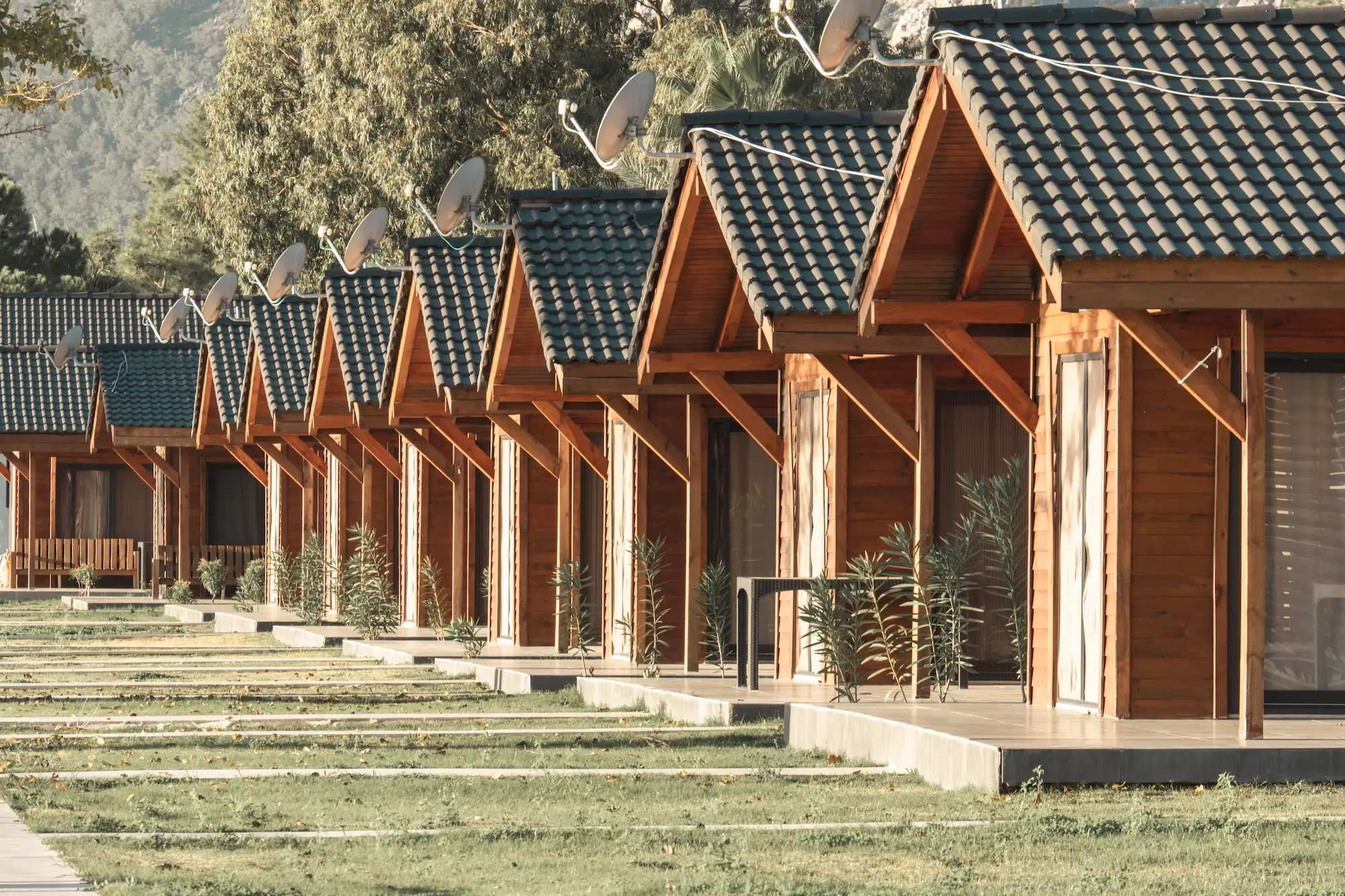
Case Study 1: Estival Park Silmar (Spain) – Management over Technology
This hotel proves that sustainability is driven by smart management. While they have large-scale renewable projects, their most applicable lesson for Albanian SMEs is their use of Standard Operating Procedures (SOPs). They run low-cost guest campaigns to reduce water use, showing that operational discipline can save money before any major investment is required. For a growing Albanian sector, this shows that establishing "green routines" and clear staff instructions can proactively manage waste and energy before investing in expensive infrastructure.
Feasible for SMEs: written SOPs, staff briefings and guest cards. Discussion material: the hotel's large-scale renewable projects, which are not a starting point for a small business.
Methodologies and Tools
Methodology: The Iceberg Model
To help learners look beyond surface-level symptoms (like a high utility bill), VET teachers should use Iceberg Model Root Cause Mapping. Learners map the situation across four levels:
| Level | Question to Ask | Definition |
| 1. Event (Surface) | What is happening? | The obvious problem we can see |
| 2. Pattern | What has been happening over time? | Trends and repeating events |
| 3. Structure | What causes these patterns? | Systems, processes, and policies |
| 4. Mental Model | Why do we have these structures? | Beliefs, values, and assumptions |
By mapping these connections, learners can propose structural interventions—like new SOPs or equipment—that change the business's long-term behaviour and economic resilience.
Tools:
To help learners and SMEs move from awareness to action, here are three essential digital tools that can help you create practical simulations/scenarios for Phase 1 (Audit) of the 30-60-90 Day Action Plan structure.
Tool 1: Hotel Carbon Measurement Initiative (HCMI) - The HCMI is a free, industry-standard methodology used to calculate and communicate the carbon footprint of hotel stays and meetings in a transparent way. It covers Scope 1 and 2 emissions (direct energy use on-site) and outsourced laundry. By inputting utility data like electricity (kWh) and gas, businesses receive standardised metrics per occupied room night. This allows SMEs to benchmark their performance and set measurable reduction targets to improve economic resilience.
- Link to HCMI: https://sustainablehospitalityalliance.org/resource/hotel-carbon-measurement-initiative/
Tool 2: Hotel Water Measurement Initiative (HWMI) - The HWMI is a free tool that enables hospitality businesses to track their water footprint with consistency. It calculates water usage per occupied room per day and per area of meeting space. The methodology covers all on-site activities, including kitchens, laundries, and gardens. Using HWMI helps SMEs identify high-consumption areas and hidden leaks, turning water management from a compliance cost into a cost-saving opportunity for long-term stability.
- Link to HWMI: https://sustainablehospitalityalliance.org/resource/hotel-water-measurement-initiative/
Tool 3: Carbon Footprint Calculator from Green Key: This tool is a digitised version of the HCMI methodology hosted on the BeCause sustainability data hub. It is specifically designed to be user-friendly for small operators with limited digital capacity. The calculator converts raw fuel and electricity logs into visual management dashboards and impact reports. It allows SMEs to prove the "business case" for circularity by showing stakeholders precise data on renewable energy use and total carbon reductions.
- Link to Carbon calculation tool: https://www.greenkey.global/carbon-calculation-tool-2
Example exercise: Iceberg Model – with Sample Answers
(The exercise uses data from the file “HWMI tool v1.1_2021_example”. From del Hotel Water Measurement Initiative (HWMI) tool: https://sustainablehospitalityalliance.org/resource/hotel-water-measurement-initiative/)
- Level 1: Event (Surface Level) - What is happening?
- Instructions:Write 1-2 sentences describing the problem that Hotel A can see right now.
- Example: "Hotel A has a high-water bill and uses a lot of water."
- Level 2: Pattern - What has been happening over time?
- Instructions:Think about trends: how has the situation changed over the past months or years? Write 1-2 sentences.
- Example: "The water bill has been increasing every year for the past five years, even though occupancy has remained stable."
- Level 3: Structure - What causes these patterns?
- Instructions:Think about the systems, equipment, processes, or policies that cause the problem. Write 1-2 sentences.
- Example: "The hotel has old plumbing fixtures (toilets, showerheads) that are inefficient. There are also undetected leaks in the piping system. The hotel doesn't have a maintenance schedule to check for leaks."
- Level 4: Mental Model - Why do we have these structures?
- Instructions: Think about the beliefs, values, or attitudes that keep the problem going. Write 1-2 sentences.
- Example: "Management has believed that 'water is cheap' and 'saving water is too expensive.' They have prioritised other investments over water conservation."
- Level 5: Solution (Putting It All Together)
- Instructions:Based on your Iceberg Model analysis, what should Hotel A do? Think about:
- What can they fix at the surface level(quick fixes)?
- What can they fix at the deeper levels(long-term solutions)?
- Instructions:Based on your Iceberg Model analysis, what should Hotel A do? Think about:
- Instructions: Think about the beliefs, values, or attitudes that keep the problem going. Write 1-2 sentences.
- Instructions:Think about the systems, equipment, processes, or policies that cause the problem. Write 1-2 sentences.
- Instructions:Think about trends: how has the situation changed over the past months or years? Write 1-2 sentences.
- Instructions:Write 1-2 sentences describing the problem that Hotel A can see right now.
Example: "Hotel A should invest in new water-efficient fixtures and create a regular maintenance program. Management also needs to change their thinking about the value of water conservation. They should track water use monthly and celebrate reductions. This will create a culture of water awareness among staff and guests."
Core Section C: Strategic VET-Business Collaboration and Mentoring Schemes
Concept Explanation
In the modern hospitality and tourism sectors, transitioning from a linear "take-make-dispose" model to a circular economy is no longer optional—it is a requirement for long-term competitiveness and environmental survival. This concept breakdown explores how Vocational Education and Training (VET) institutions and small and medium-sized enterprises (SMEs) can strategically collaborate through mentoring frameworks to drive this green transition.
Strategic VET-Business Collaboration: This refers to a structured, reciprocal partnership between vocational schools and the private sector. Instead of traditional, isolated internships, a strategic collaboration aligns the educational curriculum directly with the evolving green and digital skill needs of the market.
A prime example is placing VET learners as sustainability assistants within micro-enterprises and tourism SMEs.
- For the Business: It provides immediate, hands-on manpower to implement circular practices without high consulting costs.
- For the Student: It builds high-demand competencies in real-world environments.

Mentoring Schemes: Mentoring schemes are formalised frameworks where knowledge, expertise, and practical skills are transferred between different actors in the tourism ecosystem. In the context of circular tourism, these schemes bridge the gap between theoretical sustainability and operational reality.
Types of Mentoring Schemes
To successfully accelerate circular economy practices, three primary mentoring models can be utilised:
Industry-to-Educator Mentoring (Reverse Knowledge Transfer)
-
- How it works: Experienced tourism operators, green tech start-ups, or sustainability consultants mentor VET teachers and curriculum developers.
- Why it matters: According to the “Mapping of Circular Economy Challenge and Barriers to Implementation” report, 1% of VET teachers feel they lack knowledge or expertise on circular economy topics, and 41% cite insufficient teaching resources. This mentoring style formally equips educators to integrate real-world metrics into their classrooms.
Student-Led "Sustainability Assistant" Mentoring (Peer-to-SME Support)
- How it works: VET learners, backed by fresh training in modern circular practices (such as food waste monitoring or digital resource tracking), enter local SMEs. They act as structural assistants under the joint supervision of a school mentor and the business owner.
- Why it matters: Tourism SMEs are often paralysed by short-term operational demands. Having a dedicated assistant helps them execute projects like setting up composting loops or switching to eco-friendly supply chains.

Transnational Peer-to-Peer Mentoring (EU-Albania Exchanges)
- How it works: Pairing Albanian tourism stakeholders and VET institutions with established sustainable tourism operators in EU member states.
- Why it matters: There is an overwhelming demand (7% of surveyed Albanian VET teachers participating in the “Mapping of Circular Economy Challenge and Barriers to Implementation” report) for international encounters and study visits. This scheme bypasses local data fragmentation by allowing stakeholders to witness fully functional circular business models in action.
Relevance for Hospitality and Tourism SMEs
The tourism infrastructure in developing destinations faces unique vulnerabilities, heavily detailed in recent baseline studies:
- Overcoming Financial & Resource Gaps: A staggering percentage of tourism operators want to transition to greener operations but are restricted by upfront technology costs and limited access to green subsidies. Strategic VET collaborations act as low-cost talent pipelines that minimise the economic risks of transitioning.
- Mitigating Seasonality Pressures: Tourism peak seasons exert intense pressure on local waste, water, and energy infrastructure. Sustainability assistants can help micro-enterprises deploy circular supply chains, shared local mobility options, and waste reduction strategies that make businesses resilient during both peak and off-peak periods.
- Enhancing Market Image and EU Alignment: As regions align with EU climate goals, consumer demand for eco-conscious travel increases. Adopting circular models through a trained workforce directly increases an SME's regional competitiveness and brand value.
Summary of Benefits
| Target Group | Strategic Collaboration Benefit |
| VET Students | Gain immediate employability and work-ready green competencies. |
| Tourism SMEs | Receive structural capacity to shift from linear to circular operational workflows. |
| Local Ecosystem | Diverts waste from landfills, protects biodiversity, and creates green jobs. |
By moving away from siloed initiatives and embedding these strategic mentoring structures into national educational frameworks, the tourism sector can successfully bridge the gap between policy ideals and grassroots reality.
Examples and Case Studies
Case Study 1. Iberostar Group: Circular Hospitality (Global/Europe)
Iberostar has transformed its operations by prioritising circularity as a core business strategy. Their "Wave of Change" movement focuses on three pillars: moving toward a circular economy, responsible seafood consumption, and coastal health. For VET students, this is a prime example of the "business case" for sustainability. By eliminating single-use plastics and auditing waste at every touchpoint, they reduced operational costs and increased brand loyalty. This case demonstrates that circularity is not just ethical; it is a vital competitive advantage for modern SMEs.
Feasible for SMEs: removing single-use plastics and auditing waste at each touchpoint. Discussion material: the scale of a global group; learners identify which of its measures a small guest house could copy at low cost.
Methodologies and Tools
Methodology 1: The SMART framework is widely recognised as an effective approach to setting clear and achievable objectives. This method is used to formulate goals that are verifiable and results-driven, making it an ideal tool for SMEs and/or vocational training contexts.
SMART is an acronym that stands for:
- S - Specific: The goal must be clear, focused, and well-defined. It answers: What exactly do we want to accomplish? Why is it important?
- M - Measurable: You need to track progress and quantify success. It answers: How will we know it's done? What data will we use to measure our progress?
- A - Achievable: The goal should be realistic and attainable, given your resources and constraints. It answers: Can this reasonably be done with what we have?
- R - Relevant: The goal must align with your broader business or learning objectives. It answers: Does this matter to our business/learning? Is it the right time?
- T - Time-bound: A goal needs a deadline or a clear timeline to create urgency and focus. It answers: What is the deadline? What are the milestones?
For SMEs, setting SMART goals is a proven tool for productivity and growth. In VET, educators use SMART objectives to facilitate clear assessment and ensure that the skills taught meet industry needs.
Tool 1: SMART Goal Setting & Cost-Benefit Grid The SME manager must transition from vague ideas to SMART goals: Specific, Measurable, Actionable, Relevant, and Time-bound.
- Example: Instead of "reducing waste," a SMART goal is: "Reduce weekly organic kitchen waste by 15% within 30 days by implementing portion controls".
Link to SMART goals grid: https://www.canva.com/templates/EAGMLAnxYOo-smart-goals-planner-document-colorful-in-modern-simple-style/
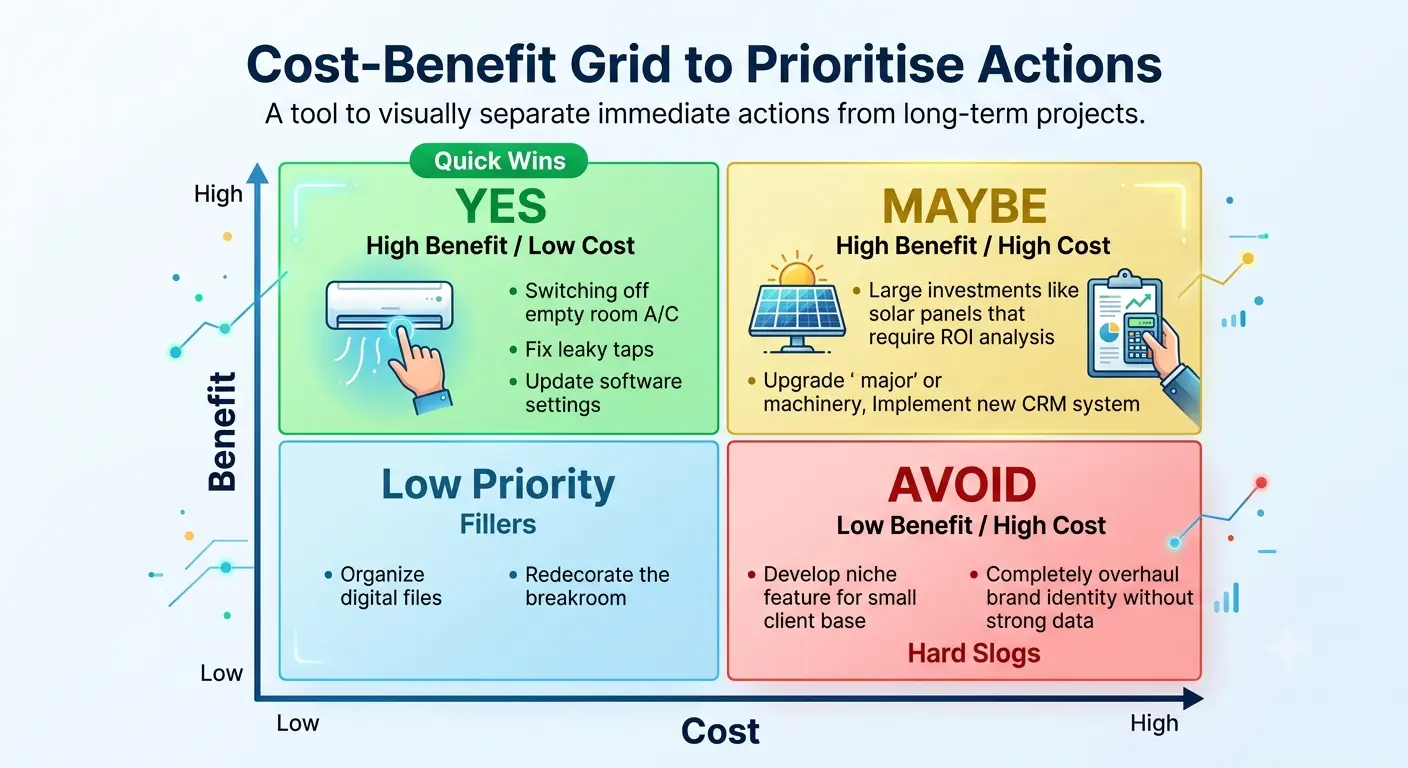
Map these goals onto a Cost-Benefit Grid to prioritise actions:
- High Benefit / Low Cost (YES): "Quick Wins" like switching off empty room A/C.
- High Benefit / High Cost (MAYBE): Large investments like solar panels that require ROI analysis.
Methodology 2: Micro-Credentialing for Tourism Sustainability
What are Micro-credentials? For a VET teacher, the most effective 'micro-credential' unit is one that is industry-recognised and modular. Micro-credentials are certified, bite-sized learning units that validate specific skills—such as circular waste management—providing a flexible, transparent bridge between classroom theory and urgent workplace needs. Rather than creating one from scratch, you can leverage existing high-quality frameworks that align with GSTC criteria to ensure your students gain credentials that are both credible to SMEs and recognised by the industry.
Micro-credentials are essential for the VET-industry ecosystem because they:
- Provide Immediate Relevance: They address specific, urgent needs in the labour market, allowing students to gain skills that are immediately applicable to an SME’s operations.
- Offer Transparency: They are assessed against clear, predefined standards, ensuring that both the student and the business owner understand exactly what skill has been mastered.
- Are Stackable: They can act as standalone certificates or be "stacked" over time, eventually accumulating into larger, formal qualifications if desired.
- Bridge the Gap: They provide a formal, recognised way to certify non-formal learning, giving SMEs confidence in the student's technical abilities without the wait time of long-term training programs.
Look into the WeNaTour Microcredentials Course. It is designed specifically for the tourism sector, is free, and covers highly relevant modules such as:
- Digital Technologies for Sustainable Destinations.
- Stakeholder Engagement & Facilitation.
How to benefit: You can use these modules as "flipped classroom" content. Have your students complete a specific module (e.g., Digital Tech for Sustainability) as a prerequisite before they enter an SME as a "Sustainability Assistant." They earn a recognised credential, and you gain a curriculum-aligned framework.
Tool 2. The "Skills Gap Mapping" Toolkit
You can utilise free, professional-grade templates that are easily adaptable for a VET-SME partnership.
Free Recommended Templates:
- Deel’s Skills Gap Analysis Template: This is excellent because it includes visual, color-coded gap identification (Red/Yellow/Green). It is perfect for an SME owner to quickly see where their staff lacks "green" skills.
- Paycor’s Skills Gap Analysis Template: This offers a clean, spreadsheet-based format that is very easy to print and bring to a meeting with a business owner.
| Step | Action | Tool to Use |
| 1. Baseline | Ask the SME owner/manager to rate their staff's current sustainability skills (1-5). | Printable Skills Gap Template: We begin by using a standardised template to inventory the SME’s existing sustainability practices. We identify gaps in areas like energy monitoring, procurement waste, or digital resource tracking. This audit objectively highlights where current skill levels do not match the business’s circularity goals. |
| 2. Prioritise | Identify the "Critical Gap" (e.g. use The Iceberg Model from Section B) and Define Objectives. | SMART Goal Setting (The "Target State" Exercise)
Together, the student and the SME owner define a specific, measurable objective. For example, instead of a vague goal of 'reducing waste,' we agree on: "Decrease single-use plastic consumption in the breakfast buffet by 20% over 8 weeks through the implementation of a bulk-dispenser system." This focuses the student’s work and provides the SME with a clear metric for success. |
| 3. Bridge | Assign a VET student to lead a project that closes that specific gap. | Project Action Plan |